
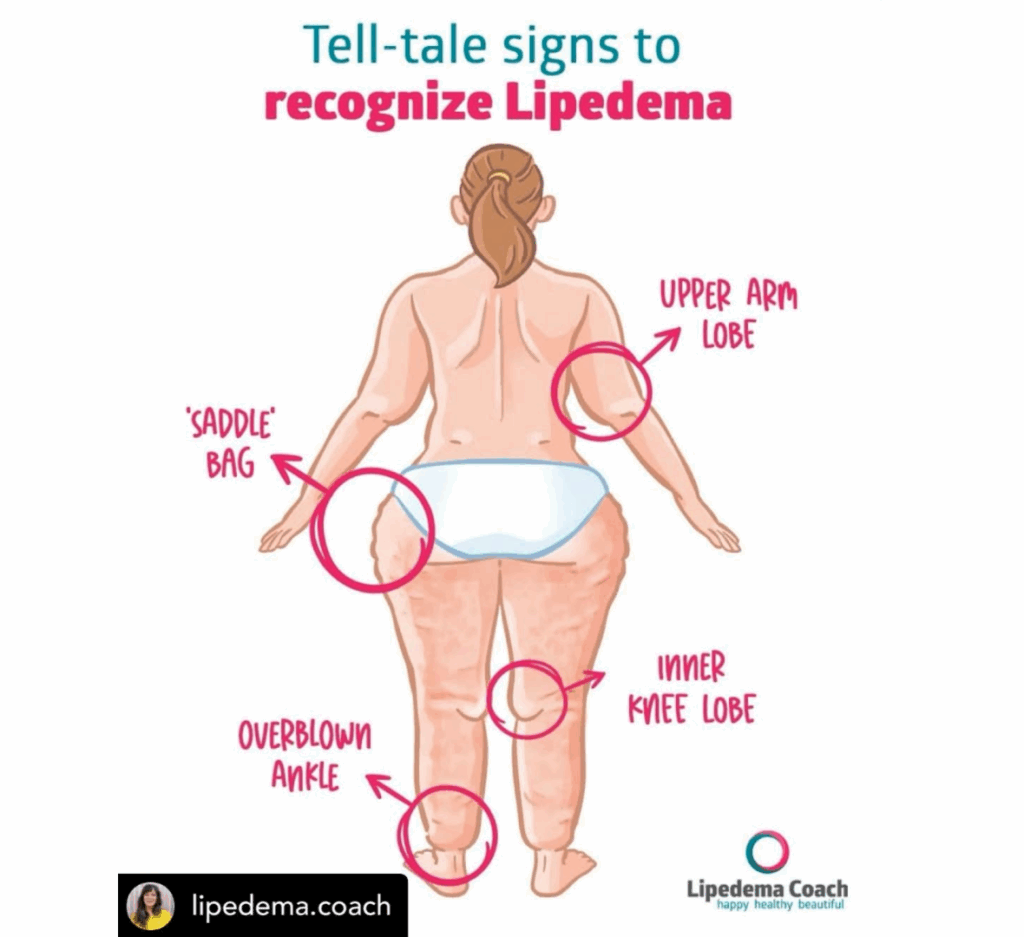
Reposted with thanks to @lipedema.coach
Is Lipedema still misdiagnosed in 2025? Sadly, Yes 
Even today, women with Lipedema continue to go undiagnosed for years, even decades. And week after week in my practice, I hear the same story:
 A woman starts noticing something’s “off” as a teenager. Her legs feel heavy, painful, and never seem to respond to diets or exercise the way the rest of her body does.
She goes to her doctor, maybe even a few.
She’s told it’s just weight gain. Hormones. Salt. Genetics.
She tries everything—restrictive diets, workouts, compression stockings—and still, nothing changes.
It often isn’t until her thirties or beyond that she finally hears the word Lipedema for the first time. And by then, the symptoms have progressed, the pain has increased, and the emotional toll has grown heavy.
This is exactly why I do what I do.
Lipedema is a progressive condition, which means early recognition makes all the difference. And it starts with knowing what to look for!
Some of the most commonly seen Lipedema symptoms:
 Noticeable size difference between upper and lower body
Fat build-up in specific areas (like saddlebags or knee lobes)
Pain and tenderness, even without pressure
Easy bruising for no clear reason
Cold sensations, especially in the legs or buttocks
Skin that feels lumpy or uneven underneath
Heavy, tired legs, even with minimal activity
Other tell-tale signs include:
 No response to diet or exercise
Swelling or fluid retention
Symptoms worsening into secondary lymphedema
Increasing mobility issues or joint pain
If this sounds familiar, you’re not imagining it, and you’re not alone.
 Keep asking questions.
 Keep learning.
 And keep fighting for the care you deserve.
Let’s make early recognition the norm, not the exception.
With love,
Rachel – Founder at Lipedema Coach
 @krijlcreatie